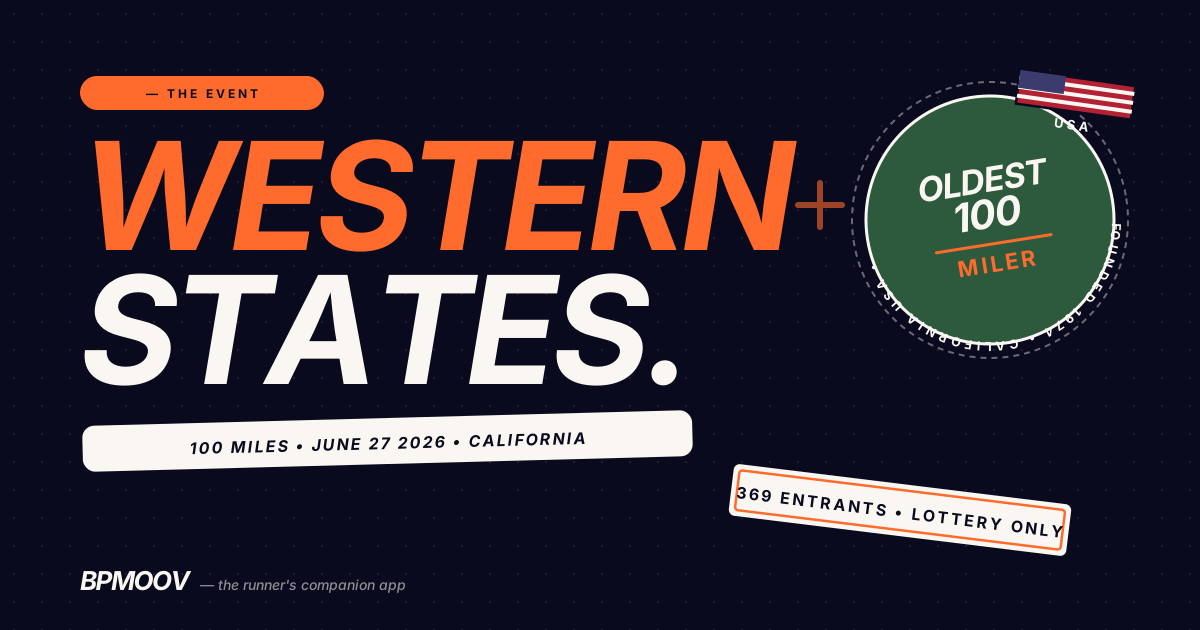
Western States 100 2026: Olson, Jornet and Hall Take On the World's Oldest 100-Miler
In short — On June 27, 2026, 369 runners will set off from Olympic Valley to Auburn, California: 161 km of mountain trails, canyons and heat. Western States, the world's oldest 100-miler, sees defending champion Caleb Olson, all-time great Kilian Jornet and defending women's champion Abby Hall return to the start line.
Some races get circled on the calendar months — sometimes years — in advance. The Western States Endurance Run is one of them. On the last Saturday of June, 369 lucky runners line up at the foot of the Sierra Nevada for one of the most mythical ultras on the planet. The 2026 date is set: June 27.
A race born from a slightly crazy bet (1974)
The Western States story starts with a horse. In 1974, American Gordy Ainsleigh was due to ride the Tevis Cup, a 100-mile equestrian race between Olympic Valley and Auburn. But his horse wasn't fit to run. Rather than give up, Ainsleigh decided to cover the 161 km… on foot. He finished in under 24 hours and, without knowing it, founded the world's oldest 100-miler.
Fifty years on, the race still carries that extra soul. Anyone crossing the line under 24 hours earns the famous silver belt buckle — a holy grail for ultra runners. The rest have until the next morning to reach the Auburn track and claim the bronze. Like Comrades in South Africa, Western States belongs to that handful of monuments that mean far more than a result sheet.
161 km of snow, canyons and furnace heat
The course packs in everything that makes ultras brutal. A high-altitude start, sometimes still in melting snow, then a long plunge into canyons where the heat can crush runners by early afternoon. That contrast — cold up high, furnace in the gorges — makes Western States a management puzzle even more than a test of legs.
The times tell the story of a rising level. The men's record belongs to Jim Walmsley, in 14:09:28 (2019), a four-time winner of the event. On the women's side, Courtney Dauwalter shattered the mark in 15:29:34 in 2023. Benchmarks that once looked untouchable… until the new generation crept dangerously close.
Men's race: the new guard meets the legends
Top of the bill: Caleb Olson, the defending champion. In 2025 he ran Western States in 14:11:25, the second-fastest time in race history, just two minutes off Walmsley's record — and only his second-ever 100-miler. He comes back in 2026 as the clear man to beat.
Right behind him, Chris Myers, runner-up last year in 14:17:39. Steady and strong, he only needs the right scenario to turn the tables.
Then there's Kilian Jornet. The Catalan, arguably the greatest trail runner of all time and the 2011 winner here, returned in 2025 after more than a decade away to finish third in 14:19:22. On a lighter racing schedule, he's still capable of a masterpiece. Add legend Jim Walmsley to the field and the men's race looks like a generational handover.
Women's race: Hall defends, Xiang attacks
On the women's side, Abby Hall wears the golden defending-champion bib. Her 2025 win in 16:37:16 — the fourth-fastest women's time in race history — carried real weight: it came after a serious knee injury that nearly ended her career. Hall thrives in hot, grinding races, and Western States is built for her.
Her main rival is Fuzhao Xiang, runner-up last year in 16:47:09. Her consistency and the growing depth of the international women's field make her a genuine contender. And there's a crop of under-the-radar names from Colorado, California and Europe who earned Golden Tickets and dream of a breakthrough — much like Rachel Entrekin did at Cocodona 250.
Why follow Western States when you run in France or Europe
Let's be honest: no reader is signing up for Western States this year. The field is capped at 369 entrants by the U.S. Forest Service to protect the trails, and access runs mostly through a lottery that draws over 10,000 applicants every year. A genuine raffle.
But you don't need to run in California to be inspired. Western States is the shop window of a sport — ultra trail running — that has its equivalents right on our doorstep: UTMB around Mont-Blanc, the Diagonale des Fous on Réunion Island, and hundreds of more accessible trails to cut your teeth on (our guide to preparing for your first trail is built for exactly that). If this late-June race makes you want to lace up for longer outings, the hardest part is done — you just need a race that fits.
That's exactly what BPMoov pulls together: registrations for road and trail races across France and Europe, from your first 10K to your first ultra. Free, on iOS and Android. → Download BPMoov.
FAQ
When is the Western States 100 in 2026?
The 2026 edition takes place on Saturday, June 27, 2026. The race starts early in the morning in Olympic Valley, California, and runners have until the next morning to reach the finish in Auburn — roughly 161 km of mountain trail.
How long is the Western States 100?
The race is 100 miles, about 161 km, running from Olympic Valley to Auburn in California's Sierra Nevada. It's the world's oldest 100-mile trail race, created in 1974 after Gordy Ainsleigh's bet to run an equestrian course on foot.
Who holds the Western States 100 record?
The men's record belongs to American Jim Walmsley in 14:09:28 (2019). On the women's side, Courtney Dauwalter set the record at 15:29:34 in 2023. In 2025, winner Caleb Olson came within two minutes of the men's record with 14:11:25.
Why is it so hard to get into the Western States 100?
The field is capped at 369 runners by the U.S. Forest Service to protect the trails. Entry mostly runs through an annual lottery that draws over 10,000 applicants, plus a few automatic spots for winners of certain qualifying races (the "Golden Tickets").
How do you qualify for the Western States 100?
You first need to finish an official qualifying ultra, then enter the annual lottery. The very top finishers of select "Golden Ticket" races earn a direct entry instead, skipping the lottery entirely.
Are there equivalent ultras in France and Europe?
Yes. UTMB around Mont-Blanc and the Diagonale des Fous on Réunion Island are Europe's marquee ultra-trail events. To get started, aim for shorter, more accessible trails — easy to find and compare in an app like BPMoov.