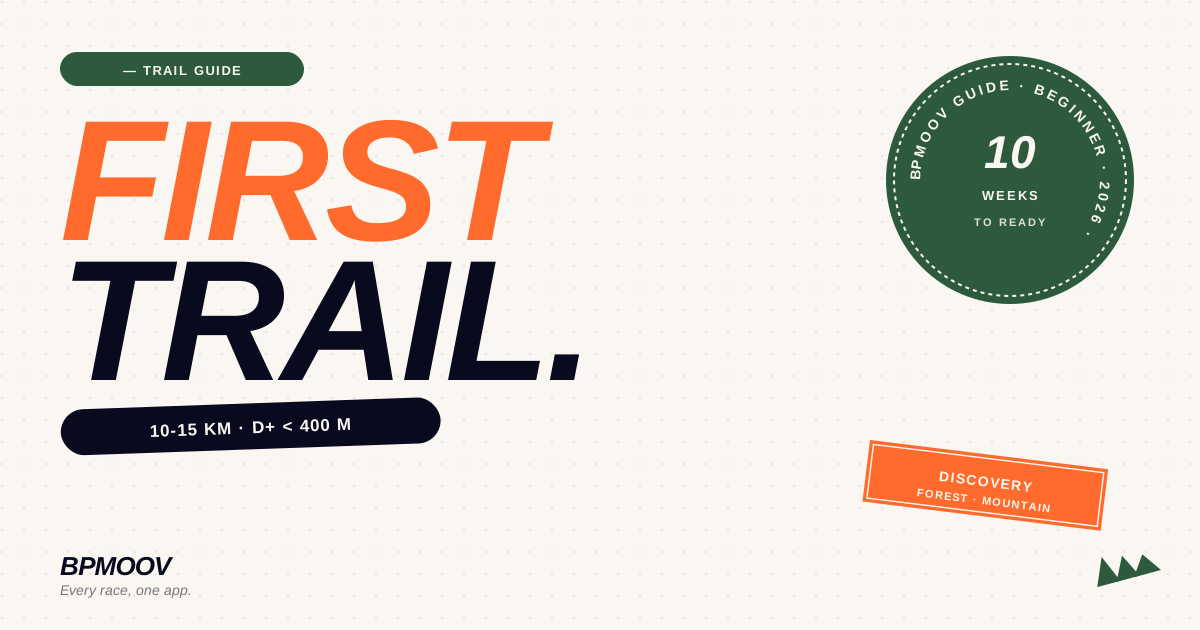
Your First Trail Run: The Complete Beginner's Guide to Preparing (and Finishing)
TL;DR — For your first trail, target a short distance (10-15 km / 6-9 mi) with modest elevation gain (200-400 m / 650-1,300 ft). Plan 8-10 weeks of prep if you already run on the road, 12-16 weeks if you're starting from scratch. Two training axes: aerobic base + terrain-specific work (hills, downhills, technical paths). Minimum gear: trail shoes, hydration pack/belt, windproof jacket. And the golden rule: on trail, you measure effort in time, not kilometers.
Trail running has exploded in popularity over the past decade — and for good reason. Leaving the asphalt behind, running through forests, climbing a summit and coming back down: it's a different world from urban running. Good news: if you already run on the road, you have most of what you need. Bad news: a trail is not just a hilly 10K — it has its own rules that nobody bothered to tell you.
This BPMoov guide pulls together what the best trail coaches (Salomon, Hoka, Trail & Running, Jogging-Plus plans) recommend for preparing a first trail properly. Practical focus: pick your race, train without injury, finish on your feet (with a smile).
What is a "trail," exactly?
Trail running is running in a natural environment, on paths, tracks and single-tracks, often with elevation. The French Athletics Federation (FFA) classifies trail races by distance:
- Discovery trail: under 21 km
- Short trail: 21 to 42 km
- Trail: 42 to 80 km
- Ultra trail: over 80 km
For your first trail, target the discovery category: 10 to 15 km is ideal. No more. That's the distance that lets you discover the format without putting yourself in physical or mental trouble.
Picking your first trail: 4 criteria that change everything
This is your first real decision. Don't make the classic beginner mistake — signing up for an "iconic" trail that's way too tough.
- Short distance: 10-15 km. Not 30, not 42. You'll have plenty of time to step up.
- Modest elevation gain: aim for 200-400 m (650-1,300 ft) of D+. Above 600 m on 15 km, it gets seriously steep.
- Not too technical: wide paths, forest tracks, no ropes, no exposed scree. Read the course description carefully.
- Mild season: spring (April-June) or early autumn (September). Avoid heat waves and snow for your first.
A few French formats that are perfect for beginners: the "discovery" distances of the MaXi-Race d'Annecy (15 km), EcoTrail Paris (18 km), the Trail des Citadelles, or the Marathon du Mont-Blanc (10 km). The Vosges, Jura and Massif Central also have plenty of small accessible local trails.
Concretely: open the BPMoov app, filter by "trail" distance and region, save 2-3 candidates with reasonable elevation. You'll get notified when registration opens. → Download BPMoov.
Trail vs road: what really changes
The first thing to wire mentally: a trail kilometer is not a road kilometer.
| Aspect | Road | Trail |
|---|---|---|
| Pace | Steady, measurable | Variable, mostly irrelevant |
| Effort reference | Pace (min/km) | Time on feet + heart rate |
| Surface | Stable, predictable | Rocky, root-strewn, uneven |
| Elevation | Near zero | The main metric |
| Walking allowed | Unusual | Strategic (steep climbs) |
| Hydration | Aid station every 5 km | Often self-sufficient |
Conversion rule: the same effort produces around 1.2-1.5 km of trail per 1 km of road. Translation: if you run a road 10K in 1 hour, plan for 1:15 to 1:30 on a hilly 10K trail.
And yes, walking is allowed. On trail, hiking up steep climbs is an elite strategy, not a failure. Save your legs uphill so you can run the rest.
The training plan: 10 weeks, 2 axes
If you already run 3 times a week on the road, 10 weeks is enough to prepare a discovery trail. Standard structure:
| Day | Session | Duration |
|---|---|---|
| Mon | Rest | — |
| Tue | Easy endurance run | 45-60 min |
| Wed | Hill repeats / uphill intervals | 45 min |
| Thu | Rest or cross (cycling) | — |
| Fri | Short easy run | 30-40 min |
| Sat | Strength / mobility | 30 min |
| Sun | Long trail run | 1 h → 2 h 30 progressive |
The two axes of progression:
- Aerobic endurance: your ability to run for a long time. Built by Sunday long runs, gradually moving from 1 hour to 2 h 30 of effort on trails.
- Terrain-specific prep: your ability to handle elevation and unstable ground. Built by hill sessions (Tuesday), technical paths (long run), and strength (Saturday).
3 golden rules:
- Never increase by more than 10% week-on-week. The classic anti-injury rule.
- 3 weeks up, 1 week down. Mandatory recovery cycle.
- Run in nature whenever possible. You won't prepare a trail by training entirely on tarmac. Find a park, a forest, a path — even 20 minutes a week makes a difference.
For the base, our First 10K guide covers fundamentals that apply to trail too.
Minimum gear (and what you DON'T need)
For a first 10-15 km discovery trail, the gear list stays reasonable.
Essential:
- Trail shoes: with lugs (4-6 mm), different from road shoes. Reference brands: Salomon, Hoka, La Sportiva, Asics, Saucony. Budget 130-200 €.
- Hydration pack or belt: 500 ml to 1.5 L depending on aid stations. Mandatory if the race isn't fully supported.
- Lightweight windproof jacket: often required by mandatory gear list. Check the race rules.
- Breathable clothing: technical t-shirt + shorts or tights depending on season.
Useful:
- Cap or buff (sun + sweat)
- Poles: not essential on a flat discovery trail. Useful above 800 m of D+.
- Headlamp: only if the race starts before sunrise or finishes after sunset.
Useless for your first:
- High-end multisport GPS watch (your smartphone is fine)
- Pack over 5 L
- Lots of energy gels (1-2 are enough on 10-15 km)
Technique: climb, descend, don't fall
Three techniques to wire before your first trail:
Climbing
Power hiking in steep ramps. Hands on thighs to push forward. It's not reasonable to run above 12-15% gradient — you'll lose more than you gain.
Descending
This is where beginners get hurt the most. Three principles:
- Short steps, fast cadence. No long strides that load the knees.
- Look 2-3 meters ahead, not at your feet. Anticipate obstacles.
- Knees slightly bent, never locked. Arms wide for balance.
Unstable ground
Place the foot flat, not on the edge. If you slip, lower the center of gravity. And accept that on trail, you sometimes fall — that's normal.
To wire these techniques before race day: descend at the end of a long run, on a moderate path, at moderate effort. Film yourself once to spot obvious flaws (overstriding, eyes too low, tense arms).
Trail nutrition (don't repeat the road mistake)
On a 10-15 km discovery trail (1 h 15 to 2 h of effort), nutrition stays simple:
- Before: light meal 2-3 h before (carbs + a little protein, low fiber). Banana 30 min before if your stomach handles it.
- During: 1 energy gel mid-race OR a soft bar + aid station hydration. Avoid heavy osmotic gels you've never used — they can cause stomach problems.
- Hydration: drink regularly in small sips (50-100 ml every 15-20 min depending on heat).
Avoid on race day: trying a new gel, a new sports drink, or a new breakfast. Everything you eat during the race should have been tested in long runs.
Race week: minimalist taper
For a discovery trail, the taper is shorter than for a marathon: 5-7 days are enough.
- D-7 to D-4: 50% of usual volume, maintain intensity (1 short quality session)
- D-3 to D-2: very short easy runs (30 min) + rest
- D-1: complete rest OR 15-20 min very easy + strides
- D-Day: race time
Pre-race (night before): tested meal (pasta, rice, couscous + lean protein + a little cooked vegetables). No alcohol, proper hydration.
Registration, safety, PPS
Good news on the paperwork front: since 2024, the traditional medical certificate is no longer accepted for race registration in France. The rule is now simple and the same for everyone, whatever the distance (5K to ultra). Any official race registration (road or trail) requires:
- Either a valid FFA license (Athlé Compétition or Athlé Running),
- Or a valid PPS (Parcours de Prévention Santé / Health Prevention Pathway).
You present one of these at bib pickup. The PPS is filled in online (a health questionnaire, with a medical consultation only if one of your answers triggers it) and stays valid for several months. Plan ahead: do it at the start of your prep, not the night before bib pickup.
Mandatory gear depends on the race. A 10-15 km discovery trail typically asks for a windproof jacket and a water reserve. Above 25 km, it ramps up significantly (survival blanket, whistle, headlamp depending on race timing). Always check the official rulebook — random gear checks at the start and bib pickup are common.
To find and register for your first trail without juggling 10 different sites: open BPMoov, filter by "trail" + your region, compare elevation, save your favorites. Official registration links are gathered in the app. → Download BPMoov.
What's next? Stepping up trail distance
Once your first trail is in the legs, two trajectories:
- Improve at the same distance (10-15 km), work on speed, target a time. Repeat the same race next year with 10-20% improvement.
- Step up distance: short trail (21 km), then trail (marathon/M+), then ultra. Allow at least 6 months between distance steps.
For inspiration, the 10 best trails to run in France in 2026 covers the classics (UTMB, MaXi-Race, SaintéLyon, EcoTrail Paris…) with their associated discovery distances.
Ready to register for your first trail? BPMoov brings road and trail race registrations into one app — free, iOS and Android, more than 2,000 events listed. → Download BPMoov.
FAQ
What distance for a first trail?
10 to 15 km maximum, with elevation gain between 200 and 400 m. That's the "discovery trail" category in the French FFA classification. Avoid starting directly with 21 km or more, especially in mountains.
How long does it take to prepare for a first trail?
8 to 10 weeks if you already run 3 times a week on road. 12 to 16 weeks if you're starting from scratch. The key factor is the Sunday long run, which should progressively move from 1 h to 2 h 30 of effort on trails.
Do you need special shoes for a trail?
Yes. Trail shoes have lugs (4-6 mm), lateral grip and reinforced rock protection. On a slightly technical trail, road shoes slip and don't cushion stones properly. Budget 130-200 € for a good beginner pair.
What's the difference between a trail and cross-country?
Cross-country runs on a closed groomed circuit (often racecourses or parks) at short distances (3-12 km). Trail runs on natural terrain, open paths, with variable elevation and technicality. Trail generally has more vertical and more surface variety.
Can you walk during a trail?
Yes — and it's actually recommended on steep climbs (above 15% gradient). Walking uphill is an elite strategy, not a failure: it saves your legs for later and you lose very little time compared to running inefficiently.
Do you need a medical certificate for a trail in France?
No. Since 2024, the medical certificate is no longer accepted. To register for any official race (road or trail, whatever the distance), you need either a valid FFA license or a valid PPS (Parcours de Prévention Santé / Health Prevention Pathway). You present one of these at bib pickup. Plan the PPS at the start of your prep.
How do you hydrate on a trail?
1 hydration pack or belt of 500 ml to 1.5 L depending on aid stations planned by the organisation. Drink in small sips (50-100 ml every 15-20 min) rather than large amounts. Many trails impose a minimum water volume in their mandatory gear list — check the rules.