Comrades Marathon 2026: 88 km and 12 Hours to Step Into Ultra Running History
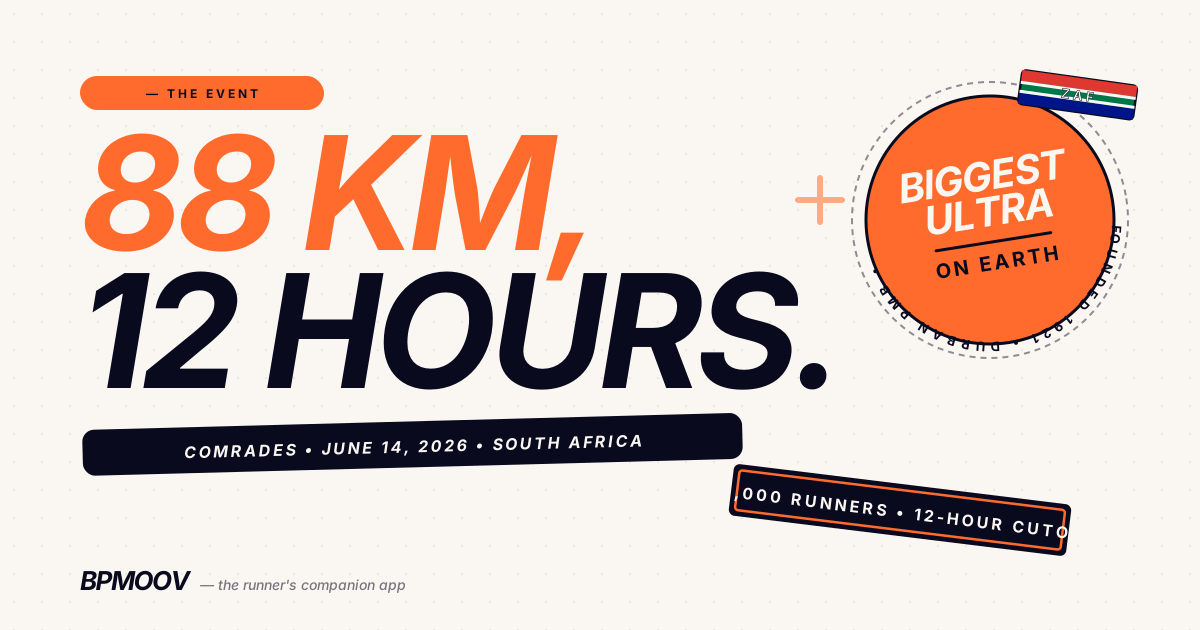
TL;DR. On June 14, 2026, more than 20,000 runners will line up between Durban and Pietermaritzburg, South Africa, for Comrades Marathon — the world's biggest and oldest ultra. 88 km of rolling roads, a strict 12-hour cutoff, a medal for every time band, and a century of history born in memory of fallen WWI comrades. Here's the full explainer.
Some races you know because you've run them. Others you know because they tell a story that resonates, even from 9,000 km away. Comrades is the second kind: the world's biggest ultra, and for many runners, the most moving one.
Three weeks before the 2026 edition, here's the breakdown — for those who don't know it yet, those who want to understand it better, and those who dream (some day) of standing on the start line in Durban.
A race born in 1921, in memory of fallen comrades
Comrades was born from a simple, powerful idea. Vic Clapham, a British-born South African railway worker who had served in East Africa during World War I, wanted to honor the comrades who had fallen at the front. Not with a monument. With a race.
On May 24, 1921, 34 men set off from Pietermaritzburg toward Durban for the first edition. 88 kilometers, no modern medical support, no GPS, no gels, no super shoes. Sixteen finished.
105 years later, the format has barely changed: 88 km between the same two cities, in the same KwaZulu-Natal province, with the same promise — finish or don't, but line up together, like comrades.
That's what makes Comrades unique. It wasn't born from a sponsor, a tourism office, or a marketing calendar. It's a memorial that grew into the world's biggest ultra.
88 km between Durban and Pietermaritzburg: the geography of the legend
Comrades is neither a trail nor a marathon. It's a road ultramarathon, and that's what makes it singular — especially for European runners who tend to associate "ultra" with "mountain."
The two cities — Durban on the Indian Ocean coast, and Pietermaritzburg inland — are connected by the N3 highway. The race alternates its direction every year:
- "Up run": Durban → Pietermaritzburg. You start at sea level and climb steadily up to around 750 m of elevation. The climber's year.
- "Down run": Pietermaritzburg → Durban. You start at altitude and lose more than 600 m of net elevation. On paper, faster. In your legs, brutal: your quads take a beating for 80 km.
Along the way, five hills have earned their own names and their own legend: Cowies Hill, Field's Hill, Botha's Hill, Inchanga, and Polly Shortts. They're called the Big Five, a nod to South Africa's iconic wildlife. Polly Shortts is the most feared: short, steep, and placed right where you don't want it — near the end on the up run, earlier and downhill on the down run, but always in your legs.
These aren't the steepest hills in the world. But stringing them together over 88 km, in a 20,000-runner field, in the middle of the austral winter (June is winter in South Africa), is what defines Comrades.
12 hours to finish: the rule that breaks hearts (and powers everyone forward)
Comrades has a cutoff: exactly 12 hours. Not 12:30. Not "we'll wait for the stragglers." At 12:00 from the start, an official turns his back to the finish line, raises the flag, and no one finishes behind him. Even if you're one meter short.
If you've ever seen a Comrades viral video, it's probably that one: dozens of runners sprinting into the stadium at 11:59:30, and some not making it. They collapse meters from the line. It gets filmed, shared, and dissected every single year. It's cruel, and that's exactly what makes the magic: Comrades tells you, before you even line up, that you're racing the clock.
12 hours for 88 km means an average pace of 8 minutes per kilometer, or about 7.3 km/h. On paper, slow. On Comrades — with the hills, the heat (yes, even in June), the mental fatigue, and the start-line density — it's exactly the right difficulty for most entrants to finish, but a meaningful portion to miss the bus.
The cutoff is part of the race's DNA. Without it, this is just a long road. With it, it's a collective drama replayed every year.
The medals: the system that makes Comrades truly unique
At Comrades, what counts isn't just finishing. It's finishing in which category. The medal system has become a slice of global running folklore:
- Gold: top 10 men or women
- Wally Hayward: sub-6:00
- Silver: sub-7:30
- Bill Rowan: sub-9:00
- Robert Mtshali: sub-10:00
- Bronze: sub-11:00
- Vic Clapham: sub-12:00
Each medal is named after a historic figure of the race. Wally Hayward, who won Comrades in the 1930s and was still finishing it deep into his elder years, lent his name to the sub-6 medal. Vic Clapham, the founder, gives his name to the "just-finishing" medal.
For an amateur runner, the classic target is Bill Rowan (sub-9) or Bronze (sub-11). For a relaxed finisher, the Vic Clapham is already a personal win.
This accessible, graded system changes how you approach the race: you race yourself, the clock, and a specific medal. Motivation that works as well for amateurs as for elites — and that you rarely find this well-designed at standard marathons.
Comrades 2026: what to expect on June 14
The 2026 edition runs on Sunday, June 14, 2026. More than 20,000 bibs have been allocated, keeping Comrades the world's biggest ultra by sheer participant count. The format is unchanged: pre-dawn start (around 5:30 local time), a long traverse of KwaZulu-Natal's hills, a mid-afternoon finish, and the strict 12-hour cutoff.
On the elite side, Comrades remains dominated by South African and Eastern European runners, with the occasional European or North American making the trip and discovering high-level road ultra. The men's course records sit around 5:13–5:30 depending on direction, women's records around 5:44–5:50 on the up run and faster on the down run.
For European and North American runners, Comrades is still rare. The race is less known abroad, more expensive to reach (long-haul flight via Johannesburg or Durban), and falls right in the middle of European trail season. But those who go almost always come back changed: the culture, the noise of the crowd, the tribal chants along the road, the entire villages turning out — none of it exists anywhere else.
Why Comrades speaks to road runners everywhere
At first glance, an 88 km race in South Africa has little to do with a marathon in Boston or a trail in the Alps. But Comrades asks a question that resonates everywhere: can you run longer than you think you can?
Three things worth noting for a road runner curious about ultra:
- It's an ultra without trail technique. No rocks, no roots, no technical descents. Just road. So it's accessible to anyone who loves pavement but wants to step past the marathon distance — without changing discipline.
- The cutoff is moderate. 12 hours for 88 km is doable for anyone who finishes a marathon under 5 hours and is willing to walk the hills. If you've already prepared a first marathon, the mental tools are mostly there.
- It's a career goal, not a whim. Many runners enter 2–3 years out, plan the trip, build Comrades into a structured season. It's a true running destination, not a random bib.
If you're not going in 2026, watch it on June 14. The race streams live on YouTube via the official Comrades channel, and the replays are gripping. And if the idea sticks, 2027 might be your year.
How to enter (for 2027 and beyond)
Comrades registration generally opens around September of the previous year, on the official website. A few conditions to know:
- Qualifying requirement: you need to have finished a certified marathon (42.195 km, officially measured) in under 5 hours within the qualifying window. No elite chrono required — just finishing a marathon on time.
- Entry fee: around 200–250 € for international runners, sometimes more depending on options.
- No lottery: first come, first served. But spots go fast — international bibs often sell out within weeks.
- Logistics: Durban has an international airport (King Shaka). About 22 hours from Paris with a layover (usually Johannesburg, Cape Town, or Doha). Austral winter means cool nights (5–10 °C) and mild days (18–22 °C). Perfect for going long.
It's less complicated than people think. The real commitment is the training: preparing 88 km on road when you've never gone past a marathon takes a full season, an honest weekly volume (80–100 km at peak), and serious recovery between long sessions.
FAQ — Everything you're wondering about Comrades
When is Comrades 2026?
The race takes place on Sunday, June 14, 2026, between Durban and Pietermaritzburg in South Africa's KwaZulu-Natal province.
What's the exact distance of Comrades?
The course is around 88 km. The exact distance varies slightly each year depending on direction (up or down run) and minor route adjustments. Officially, expect an ultra between 88 and 90 km.
Is Comrades a trail race?
No. Comrades is a road ultramarathon. No dirt paths, no single track, no mandatory gear like a pack or headlamp. Pavement from start to finish.
How long does it take to finish Comrades?
The strict cutoff is 12 hours. Elite winners finish around 5:15–5:30 for men, 5:45–6:00 for women. The average amateur runner targets between 9 and 11:30.
How do you qualify for Comrades?
You need to have finished an officially certified marathon under 5 hours within the qualifying period (typically August → April of the year before the race). No lottery — registration opens on fixed dates (usually September) and goes until bibs are gone.
Do many international runners take part?
Yes, but they're still a minority. Comrades draws a few thousand international runners each year (out of ~20,000), with the field growing steadily as road ultra culture spreads beyond South Africa.
What's the Comrades course record?
Course records sit around 5:13 for men and 5:44 for women depending on direction, but they get challenged regularly — especially since the spread of carbon-plate super shoes.
The takeaway
Comrades is ultra running's origin story: a century of history, a hard cutoff, and a medal system that turns every finish line into a personal moment. It's also a useful reminder: you don't need mountains to live an ultra that changes your life.
If the idea is in your head, June 14 is a good day to sit down and watch the race — and decide, or not, that this is your 2027 goal.
Planning your next marathon or first ultra? BPMoov lists registrations for road and trail races across France and Europe — free, iOS and Android, 2,000+ races indexed. → Download BPMoov.