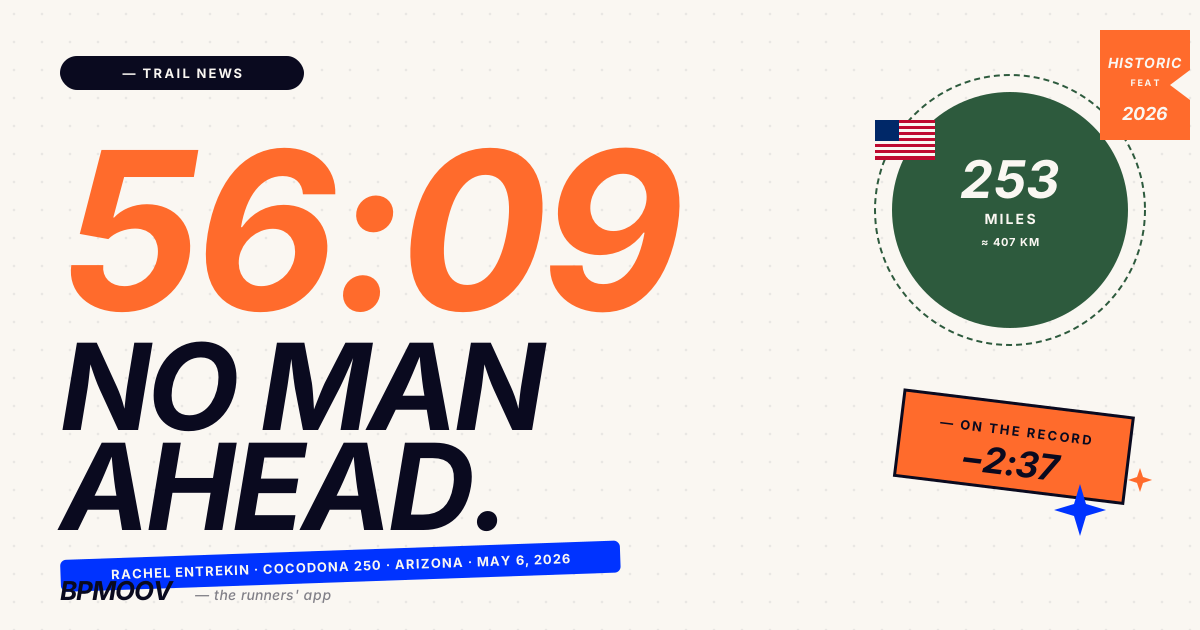
56:09 and No Man Ahead: Rachel Entrekin Wins Cocodona 250 Outright
TL;DR — On Wednesday May 6, 2026, American Rachel Entrekin won the Cocodona 250 (≈ 253 miles / 11,600 m of elevation gain in Arizona) in 56:09:48 — becoming the first woman to win the iconic ultramarathon outright, ahead of every man in the field. She broke her own women's record by nearly eight hours and Dan Green's overall course record of 58:47:18 (2025) by 2 hours and 37 minutes. Kilian Korth finished 2nd in 57:28:36, a new men's course record.
Not a women's win. A win, period — on one of the most extreme races on the global calendar. Here's what happened in the Arizona desert, what it means for ultra running, and why it matters even to amateur runners in Europe.
What happened in the Arizona high country
Monday May 4, 2026, 5 a.m. local time. Nearly 400 runners set off from Black Canyon City, in the Sonoran desert, heading for Flagstaff at 2,100 m elevation. Ahead of them: 253 miles of trails, canyons and high plateaus — roughly 407 km. Nearly 38,000 feet of vertical gain (over 11,600 meters). A 125-hour cutoff — close to five days and five nights non-stop.
This was the 5th edition of the Cocodona 250, which has quickly become the reference race in the booming American "200-miler" scene — those ultras that go beyond 300 km and now form the most extreme edge of the sport.
On Wednesday May 6, after 56 hours, 9 minutes and 48 seconds, Rachel Entrekin crossed the finish line in Flagstaff. Not first woman. First, period.
It's the first time in five editions that a woman has won Cocodona 250 outright. About 1 hour and 19 minutes later, Kilian Korth crossed the line in second place, also setting a new men's course record in 57:28:36.
What it means: −8 hours and 2.5 times the distance of UTMB
To grasp the scale, you have to put the performance in context.
The distance. Cocodona 250 is about 2.5 times the length of UTMB Mont-Blanc (171 km), with comparable elevation gain. Except at UTMB, the best runners finish in 19-20 hours without sleep. At Cocodona, the effort is measured in days, not hours.
The times. The overall course record Entrekin just shattered belonged to Dan Green since 2025, in 58:47:18. She beat it by 2 hours and 37 minutes. Her own women's record from 2025 (63:50:55) fell by nearly eight hours. At this level of ultra, those are massive gaps, not marginal ones.
The sleep. According to Marathon Handbook, Entrekin slept just 19 minutes total during the 56-hour race. Sleep management has become a central topic in 200-milers: sleep too much, you give up 1-2 easy hours; sleep too little, you risk hallucinations, falls, injuries.
Her story: three Cocodonas, three jumps, one summit
Entrekin didn't come out of nowhere. Cocodona 2026 was her third consecutive start — and her third win in a row.
- 2024 (debut): won the women's race in 73:31:25, finished 11th overall.
- 2025: came back, won in 63:50:55, finished 4th overall, set the women's course record.
- 2026: the apex. 56:09:48, 1st overall, new course record across all categories.
Three editions, 17 hours shaved from her own time, and a sport changing before our eyes. Originally from Madison (Alabama), with a doctorate in physical therapy since 2016, Entrekin is 34 and now lives in Conifer, Colorado.
The men's race: Kilian Korth erases 1:19 from the previous record
Entrekin's performance overshadowed another huge story: Kilian Korth, who had DNF'd Cocodona twice before this edition, posted the second-fastest time in Cocodona history across all categories at 57:28:36. He broke Dan Green's previous men's record (58:47:18) by more than an hour.
At this level, it's important to understand that men's and women's records are converging. On races where the limiting factor isn't VO₂ max but resilience, sleep management, fueling and consistency, the gap between sexes narrows sharply. Cocodona 2026 just made that case in the most dramatic way possible.
Cocodona is the mirror of a sport in flux
Entrekin's story isn't isolated. "200-milers" are the fastest-growing segment of global ultra running — Cocodona 250, Moab 240, the Triple Crown of 200s in the U.S. The format goes beyond 300 km, demands 60 to 80 hours of effort, and reshuffles the deck on what matters: less raw speed, more self-management.
It's precisely the type of race where women, statistically, perform closest to men — and sometimes ahead of them. Camille Herron, Courtney Dauwalter, Jasmin Paris (first woman finisher of the Barkley Marathons in 2024) had already opened the door. Entrekin walks through it with an overall course record at one of the biggest 200-milers on the calendar.
345,000 people watched the Cocodona live stream on Wednesday May 6 alone, the day of Entrekin's finish (figure reported on LetsRun.com's forum). A signal of where the sport is going: ultra is no longer niche, and women are the headliners.
The 2026 edition was also marked by tragedy
The 2026 edition was marred by tragedy: a runner died during the race after a medical emergency, with organizers declining to publicly release the runner's name or the exact cause. The race continued in their honor at the family's request, according to the organizers. A sobering reminder of the risks built into these extreme distances, and the humility they demand from everyone — from international stars to anonymous finishers.
Why this win matters for amateur runners in Europe too
Cocodona takes place in Arizona, 9,000 km from us, and few European amateurs will toe the line for 250 miles this summer. And yet, two things concern the entire European running community:
- The 200-miler movement is coming to Europe. The first races of the kind are emerging on the continent — Tor des Géants in Italy's Val d'Aoste, Tor des Glaciers, Spine Race in the UK, and new formats announced in France and Switzerland. What's playing out at Cocodona today shapes what European ultra will look like tomorrow.
- The "men always win" myth is collapsing. The consequences go well beyond ultra: they reshape women's place in long distances — including more accessible 50-80 km trails, where the M/W gap has been narrowing for five years.
Training for your next marathon or your first trail? BPMoov brings together race registrations for road and trail across France and Europe — free, iOS and Android. → Download BPMoov
FAQ
Who is Rachel Entrekin, the 2026 Cocodona 250 winner?
Rachel Entrekin is a 34-year-old American ultrarunner, originally from Madison (Alabama), with a doctorate in physical therapy since 2016, now based in Conifer (Colorado). The 2026 Cocodona was her third consecutive victory on this race — 2024 (11th overall), 2025 (4th overall), and 2026 (1st overall).
What's the exact distance of the Cocodona 250?
Cocodona 250 covers about 253 miles, or ≈ 407 km, between Black Canyon City and Flagstaff in Arizona. Total elevation gain is roughly 38,000 feet (≈ 11,600 m). The cutoff to finish the race is set at 125 hours, just over five days.
What's the current Cocodona 250 course record?
Since May 6, 2026, the overall course record (across all categories) belongs to Rachel Entrekin in 56:09:48. The previous overall record was held by Dan Green in 58:47:18 (2025). On the men's side, Kilian Korth set the new men's course record at 57:28:36 at the same 2026 edition.
Has a woman ever won a major ultra outright?
Yes, and increasingly often. Camille Herron won the Spartathlon outright in 2017, Courtney Dauwalter has won multiple ultras outright, and Jasmin Paris became the first woman to finish the Barkley Marathons in 2024. Rachel Entrekin joins this list with her Cocodona 250 win in 2026 — a first in that race's five-year history.
How does Cocodona 250 compare to UTMB Mont-Blanc?
Cocodona 250 is about 2.5 times the distance of UTMB (171 km), with comparable elevation gain spread over five days non-stop. At UTMB, the best finish in 19-20 hours without sleep; at Cocodona, the effort is measured in days, and sleep management becomes a sport of its own.
Is there an equivalent of Cocodona 250 in France or Europe?
Not exactly, but Europe is building its own "200-miler" ecosystem: Tor des Géants (~330 km in Italy's Val d'Aoste), Tor des Glaciers (~450 km), Spine Race in the UK, plus several French formats in development. For ambitious runners, these are the natural gateways into this new ultra territory.
More French ultra news: Vincent Esmiol Wins MIUT 2026. For upcoming trail registrations: The 10 best trails to run in France in 2026.