97 Grams, $500, 3 World Records: Everything to Know About the Adidas Adios Pro Evo 3
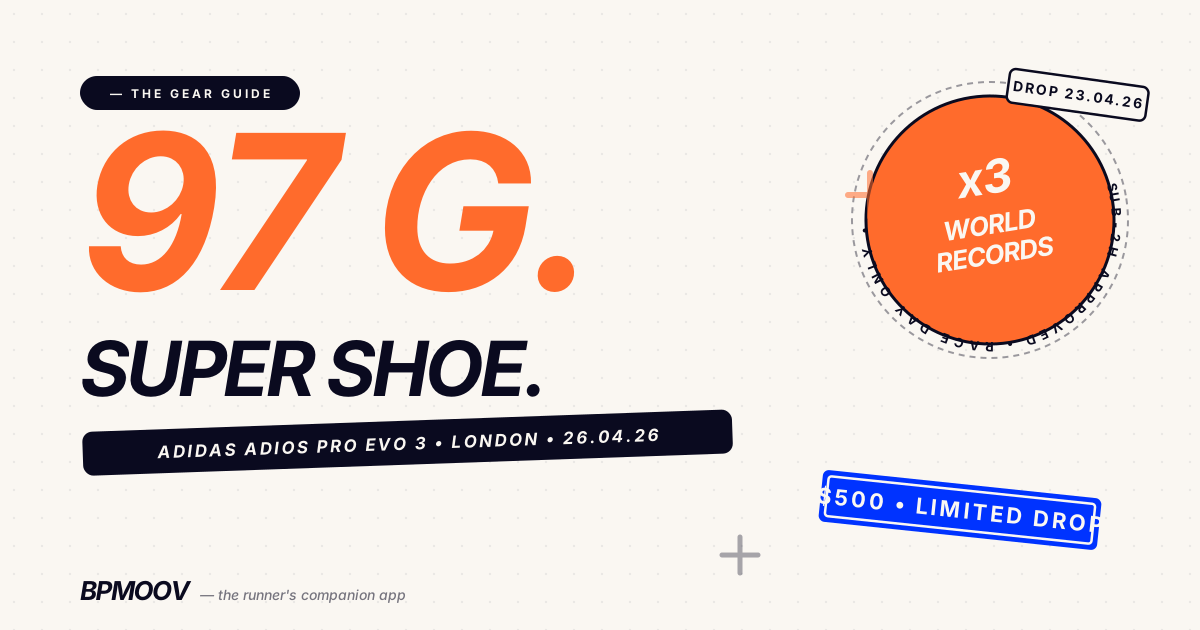
97 grams. $500. Three world records in two hours. On April 26, 2026, in London, Sabastian Sawe, Yomif Kejelcha and Tigst Assefa wrote one of the wildest pages in marathon history. On their feet: the same shoe. The Adidas Adios Pro Evo 3.
First officially recognised sub-2-hour marathon. Runner-up also under two hours. New women-only world record. One pair behind it all. So yes, we're going to look inside it.
The Adios Pro Evo 3 — quick spec sheet
- Weight: 97 g (men's US 9.5), first sub-100 g super shoe ever
- Price: $500 (extremely limited drop via the adidas Confirmed app)
- Released: April 23, 2026 — three days before London
- Records set: 3 (1:59:30 Sawe, 1:59:41 Kejelcha, 2:15:41 Assefa women-only)
- Current resale: $1,671 to over $5,000 a pair
Three world records in two hours
Sunday April 26, 2026, London Marathon:
- Sabastian Sawe (KEN) crosses the line in 1:59:30 — first sub-2-hour marathon in history ratified by World Athletics.
- Yomif Kejelcha (ETH) finishes in 1:59:41 — in his marathon debut.
- Tigst Assefa (ETH) wins the women's race in 2:15:41 — new women-only world record (non-mixed race), shaving one second off her own time.
Four of the top five men were in Adidas, all wearing the Adios Pro Evo 3. It's Adidas' biggest marathon day ever — and arguably the biggest day in the history of any single running shoe.
Read the full story of Sawe's record →
Why 97 grams matters
- Adios Pro Evo 1 (2023): 138 g. The shoe Tigst Assefa wore when she shattered the women's marathon WR in Berlin (2:11:53).
- Adios Pro Evo 2 (2025): 138 g again. Tech iteration, same target weight.
- Adios Pro Evo 3 (2026): 97 g. First officially raceable shoe under 100 g.
41 grams shaved in two years — on a US 9.5, not a tiny size. That's a massive jump.
Where did it come from? Adidas overhauled two key pieces:
- A new Lightstrike Pro Evo foam, roughly 50% lighter than the previous version, halving the midsole's density at equal volume.
- A textile-synthetic upper with an ultra-fine weave inspired by kitesurfing sails, which slashes upper weight while still locking the foot.
Underneath the foam, you'll find the standard super-shoe carbon plate — the piece that "returns" energy on each stride and offloads the calf at toe-off.
Adidas claims +11% forefoot energy return versus the Pro Evo 2, and +1.6% running economy measured in lab. Across a marathon, those two percentages translate into seconds per kilometre — therefore minutes on the final clock.
$500 retail, $5,000 on resale
The Adios Pro Evo 3 dropped on April 23, 2026 — three days before the London Marathon — exclusively on the adidas Confirmed app, in an extremely limited release.
Official price: $500 (around €460).
What happened next was predictable: the gap between demand and supply exploded. On resale platforms (StockX, GOAT, eBay), pairs were trading days after London between $1,671 and over $5,000.
The resellers' calculation is simple: this is the shoe of the two fastest men in marathon history over 42.195 km. Sports collectors' market mechanics, doing their thing.
For Adidas? On April 27, the day after the marathon, the brand's stock climbed sharply on the Frankfurt exchange. Analysts called it a textbook campaign: tight drop, historic record, a Monday morning that pushed sales of "civilian" models like the Adios Pro 4 and the Adizero EVO SL. Sawe didn't just break a record. He sold an entire brand.
Do super shoes really make you faster?
It's THE question for amateur runners. Short answer: yes, but with caveats.
Meta-analyses published since 2018 on super shoes (PEBA-foam + carbon-plate models) converge on a 2-4% running-economy improvement. For runners, that means:
- 4:00 marathoner: potentially 5 to 9 minutes saved if your mechanics agree with the model.
- 3:30 marathoner: 4 to 7 minutes.
- Sub-3 marathoner: 3 to 5 minutes.
These gains are real — not placebo. But they depend on a few things:
- Pace matters. The carbon plate's rocker effect works better at faster paces (roughly under 8:00/mile, or 5:00/km). A 10:30/mile runner benefits less, though the benefit isn't zero.
- Biomechanics vary. Some runners get 4%. Others get 1%. It depends on foot strike, cadence, calf stiffness.
- Wear is fast. PEBA-foam super shoes lose their properties in 150 to 250 miles, versus 400-500 for daily trainers. At $500 a pop, the cost-per-mile starts hurting.
This is why the rule among advanced runners is: super shoe = race day and key sessions only. Not daily mileage.
Should you buy a super shoe for your marathon?
Buy a super shoe if:
- You run your marathon in under 4:30
- You've completed at least 2-3 marathons (or 5-6 halves) already — your mechanics are settled
- You're chasing a PB and the expected gain is a few minutes
- Your budget can absorb a short-life-cycle investment
Skip the super shoe (for now) if:
- It's your first marathon — pick comfort and stability instead (Saucony Endorphin Speed, Asics Magic Speed, Adidas Adizero Boston)
- You run at a very controlled or very slow pace — the economy gain is marginal
- You're injury-prone: the carbon plate's stiffness can overload the Achilles tendon and forefoot
And the Adios Pro Evo 3 specifically? For an amateur runner, it's essentially out of reach: tiny drop, untouchable resale price, maximum fragility. It's a showcase shoe for elites, not a mass-market product.
That doesn't mean Adidas leaves you out. The Adios Pro 4 (the "civilian" sibling) is expected at a much more reasonable price. Direct competitors — Nike Alphafly 3, Asics Metaspeed Sky Paris, Saucony Endorphin Elite 2, Hoka Cielo X1 2.0 — offer comparable performance for $260-$340.
What the Pro Evo 3 says about tomorrow's marathon
A sub-100 g shoe doesn't change a single race so much as redefine what's possible. Three trends emerging since Sunday:
- Sub-2 will become an elite standard, not an outlier. Sawe and Kejelcha both broke the barrier in the same race. Next year, it'll be five.
- The tech will trickle down. What's $500 and 97 g today will be €200 and 150 g in 24 months, in shoes you'll wear at your marathon. That's how the 2017 Vaporfly ($250) became, step by step, the industry baseline by 2026.
- Regulation will tighten. World Athletics has already capped road-racing midsole stack height at 40 mm and limited plate count. Future innovation will live within those ceilings.
For you, the amateur runner, none of this changes the fundamentals: the final clock still depends on your training plan, sleep, nutrition, course choice, weather, and race-day strategy. The shoe is the last 1%. A pretty 1%, but the last one.
FAQ — The Adidas Adios Pro Evo 3 explained
What shoe was Sabastian Sawe wearing for his sub-2 record in London?
Sabastian Sawe wore the Adidas Adizero Adios Pro Evo 3, launched on April 23, 2026. It's the first officially raceable shoe in the world to clear the 100-gram bar (97 g exactly in US men's 9.5). It pairs a Lightstrike Pro Evo midsole with a carbon plate, and uses a kitesurfing-sail-inspired upper weave.
How much does the Adidas Adios Pro Evo 3 cost?
The retail price is $500 (around €460), available exclusively on the adidas Confirmed app and in very small quantities. On resale (StockX, GOAT, eBay), pairs were trading in early May 2026 between $1,671 and over $5,000.
Do super shoes really make you run faster?
Yes — studies converge on a 2 to 4% running-economy improvement compared to a regular shoe, which translates to roughly 5 to 9 minutes gained on a 4:00 marathon. The gain is sharpest at faster paces (under 5:00/km) and varies with each runner's biomechanics.
What super shoe should I buy for my first marathon?
For a first marathon, prioritise comfort and stability over raw speed. Look at "performance trainers" like the Saucony Endorphin Speed, Asics Magic Speed, or Adidas Adizero Boston. They're less aggressive than a true super shoe and cost $150-$200. Once you have a few marathons in the legs, you can move up to a real super shoe (Adios Pro 4, Alphafly 3, Metaspeed Sky Paris).
How long does a carbon-plate shoe last?
A PEBA-foam super shoe lasts about 150 to 250 miles before losing its energy-return properties, versus 400 to 500 for a daily trainer. That's why advanced runners reserve their super shoes for races and key workouts only — not daily mileage.
Where can I race a marathon to actually use my super shoe?
Autumn 2026 offers a dozen great marathons in France and Europe — flat courses, big atmosphere, perfect for chasing a PB in carbon. We've put together the full calendar here.
The shoe doesn't run for you
$500, 97 grams, three world records. The Adios Pro Evo 3 is an impressive piece of engineering — and a marketing masterclass. But it won't run your marathon for you. Threshold, long runs, sleep, nutrition, race strategy: that's what decides the clock. The shoe only amplifies work that's already been done.
Preparing your next marathon? BPMoov gathers race registrations across France and Europe — free, iOS and Android, 2,000+ races listed. → Download
Have a great season. And see you on the start line.
Article published May 2, 2026. Sources: World Athletics, Adidas Press Newsroom, Marathon Handbook. Resale prices change daily.