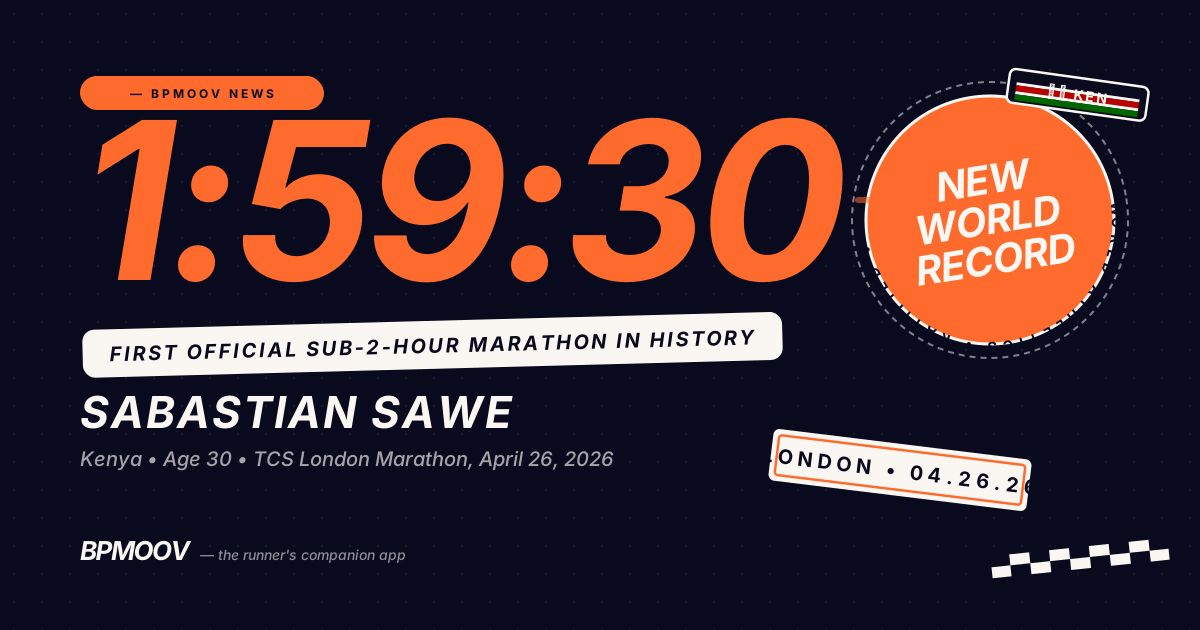
1:59:30 — Sabastian Sawe just broke the 2-hour marathon barrier
Sunday, April 26, 2026, 11:31 a.m. on the Mall in London. Sabastian Sawe crosses the finish line of the TCS London Marathon in 1 hour, 59 minutes, 30 seconds. He becomes the first human being to run an official marathon under two hours. He takes 65 seconds off Kelvin Kiptum's previous world record (2:00:35, Chicago 2023). One of sport's most legendary barriers has fallen for good.
If you lace up your shoes — even just one Sunday morning a month — what just happened deserves your attention. Here's why, and what it actually means for you.
The world record splits — London 2026
- Sabastian Sawe (KEN) — 1:59:30 🇰🇪 — world record
- Yomif Kejelcha (ETH) — 1:59:41 🇪🇹 — marathon debut
- Jacob Kiplimo (UGA) — 2:00:28 🇺🇬
The moment marathon history changed
For 25 years, two hours was the marathon's mental Everest. Everyone knew it would fall someday. No one knew when. No one knew who.
In London on Sunday, Sabastian Sawe ended the debate.
The 30-year-old Kenyan hit halfway in 1:00:29. No collapse coming — just a man deciding to push. He covered the second half in 59:01. A negative split on the fastest marathon ever run. Unprecedented.
Behind him, Ethiopia's Yomif Kejelcha, in his marathon debut, finished in 1:59:41. Also under two hours. Also writing himself into history — without even running the perfect race.
Bronze? Jacob Kiplimo, the Ugandan former half-marathon world record holder, in 2:00:28. Twenty-eight seconds off two hours, in third place. That's the depth of this race.
Why 1:59:30 is genuinely insane
To grasp the scale, hold three facts in your head:
- The previous world record was 2:00:35 (Kelvin Kiptum, Chicago 2023). Sawe took 65 seconds off it. At this level, records are chipped away in seconds — not minutes.
- Eliud Kipchoge had run a marathon in 1:59:40 — but in Vienna in 2019, in a non-competitive format (Ineos 1:59 Challenge), with rotating pacers and perfect conditions. The time was never ratified. April 26, 2026 was a real race, with a bib, a mass start, and World Athletics rules. Sawe's 1:59:30 is official.
- The pace: Sawe held 2:50 per kilometer for 42.195 km. Or in imperial: 4:33 per mile, for 26.2 miles. That's faster than the 800 m world record from 70 years ago — sustained for two hours.
And he did it without lab-grade conditions. On London streets. In a real race against 35,000 other runners.
The moment you recognize yourself (yes, you)
You're reading this and thinking: "OK, 1:59:30 is wild. But I run 4:30, this changes nothing for me."
Except it does.
Every amateur who finishes a marathon trains on the same principles as Sawe: threshold, race-pace work, long runs, recovery. The difference is scale, not nature. The same mechanisms that took a Kenyan from 2:02:05 (his very first marathon, Valencia 2024) to 1:59:30 in two years are the same mechanisms that can take you from 4:30 to 4:00. Or 4:00 to 3:30.
What makes this run inspiring isn't that it's untouchable. It's the reminder of what a human can do with a bib, a pair of shoes, and a well-built race calendar.
Yours starts here 👇
→ Find your next marathon on BPMoov
And in the women's race? Assefa shatters the record too
The same day, on the same course, Tigst Assefa (Ethiopia) won the London Marathon in 2:15:41, a new women-only world record (women's-only race format). She improved her own record from 2025 by one second.
And there's more: three women went under 2:16 in the same race:
- Tigst Assefa (ETH) — 2:15:41 — women-only world record
- Hellen Obiri (KEN) — 2:15:53 — personal best
- Joyciline Jepkosgei (KEN) — 2:15:55
Also unprecedented. London 2026 wasn't a marathon — it was an earthquake.
What this means for you, the everyday runner
Let's get concrete. Here's what this performance should change in how you approach your running:
1. Re-examine your mental ceiling
Your current limits are probably not your real limits. Smart pacing — starting just under target pace, accelerating in the second half — works at 4:30 just as well as at 1:59:30. That's what Sawe did. It's what you can do.
2. Build a season, not a one-off race
Sabastian Sawe didn't run a single marathon before this record. He ran Valencia 2024 (2:02:05, debut), Berlin 2025 (2:02:16), London 2026 (1:59:30). Three marathons in 18 months, with a deliberate progression. Recreational runner? Same logic, your scale: a half in May, a marathon in October, another the next spring. Stacking races is what makes you better — not the one-off.
3. Pick races that pull you forward
Sawe set his record on a flat course, with deep competition and a flawless event. Amateurs chasing a PR should apply the same logic: Paris Marathon, Nice-Cannes, Toulouse, Lyon, Berlin… Flat + well-organized + great atmosphere = your best times.
4. Track, plan, don't wing it
Records don't fall from the sky. They're built on a precise calendar and rigorous tracking. That's exactly what BPMoov was built for: your race calendar, your registrations, your times, your next start lines — all in one place.
2,000+ races across France and Europe. No fluff. Just your season, dialed in.
Sabastian Sawe in three key dates
To understand the trajectory of the man who just rewrote the record book:
- December 1, 2024 — Valencia Marathon (debut). Sawe wins his very first marathon in 2:02:05, the world's leading time of the year. Nobody saw this level coming.
- September 2025 — Berlin Marathon. Wins in 2:02:16, second major win. The trajectory crystallizes.
- April 26, 2026 — London Marathon. 1:59:30, world record, first official sub-2 in history. The summit.
Three marathons. Three wins. And a legendary barrier broken.
FAQ — The marathon world record in 2026
Who holds the marathon world record in 2026?
As of April 26, 2026, the men's marathon world record is held by Sabastian Sawe (Kenya) at 1:59:30, set at the TCS London Marathon. On the women's side, two records co-exist: the mixed-race world record belongs to Ruth Chepng'etich (2:09:56, Chicago 2024), and the women-only world record is held by Tigst Assefa (2:15:41, London 2026).
Sabastian Sawe or Sebastian Sawe — what's the correct spelling?
The official spelling is Sabastian Sawe (with an A), confirmed by World Athletics, the London Marathon, and the Kenyan federation. "Sebastian Sawe" is a common misspelling but it's incorrect.
Why didn't Eliud Kipchoge's 1:59:40 in 2019 count?
Kipchoge's 1:59:40 in Vienna in 2019 (Ineos 1:59 Challenge) was never ratified by World Athletics because the race was not an official event: rotating pacers, a laser car setting the pace, a closed course, no official competition. The achievement was incredible but not comparable to a competition marathon. Sawe's 1:59:30 is, by contrast, fully official.
How long does it take to train for a marathon as an amateur?
For an amateur targeting a first marathon, plan for 12 to 16 weeks of structured training, starting from a one-hour continuous run base. To target a specific time (sub-4, sub-3:30…), a 16- to 20-week cycle is recommended.
Where can I run my next marathon in France?
The most accessible French marathons for amateurs are Paris, Nice-Cannes, Run In Lyon, Toulouse Métropole and the Mont-Saint-Michel Marathon. We put together the complete calendar of the 10 best marathons to run in France in 2026 — bookmark it.
You watched Sawe run. Now it's your turn.
On April 26, 2026, Sabastian Sawe redefined what a human can do over 42.195 km. You have an entire season ahead of you to build.
The first step isn't a training plan. It's a bib to claim.
BPMoov brings together every marathon and road race registration in France and Europe, with registration alerts, your personal calendar, and runner reviews. Free. iOS and Android.
Train well. We'll see you on the start line.
Article published April 27, 2026, the day after the record. Times cited come from the official TCS London Marathon 2026 results. We'll update if any time is amended after IAAF/World Athletics ratification.